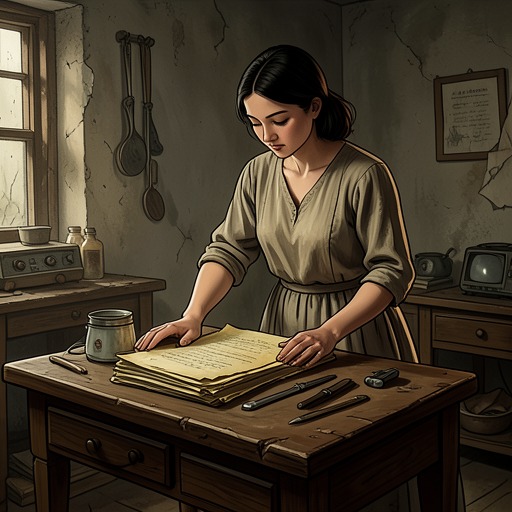
Anne Shirley and her birth parents
Anne of the IslandAnne Shirley’s bond with her birth parents, Walter and Bertha Shirley, begins in absence and is transformed by a return to the place where her life began. Anne has no remembered life with them and, until her visit to their former home in Bolingbroke, no object that belonged to her mother. There she finds the family letters that make her parents more than names attached to her orphanhood: their courtship, tenderness, and young parenthood become legible to her in their own words.
Loss and the Unknown Family Past
Anne’s mother died in the east room where Anne was born, and Walter and Bertha Shirley did not live much longer. These losses left Anne without a continuing relationship with either parent and without the ordinary material keepsakes through which a family’s history might be passed down. The furniture had been sold to pay the doctor’s bills, and her mother’s clothes and small possessions had gone to another household. Anne later says she has not had a single thing that belonged to her mother. Her connection to her parents has therefore been less a remembered relationship than a question about origins, sustained by imagination and longing.
That longing shapes Anne’s visit to Bolingbroke with Phil Gordon. The shabby yellow house on an out-of-the-way street is one she has often pictured; she is delighted that it still has the yellow paint she imagined, a lilac tree by the gate, and muslin curtains in the windows. The visit brings her imagined past into contact with a specific, modest place. It is not a recovered home in which she can resume a family life, but it gives her a setting in which the history of her birth can be encountered directly.
The Birthplace and the East Room
The woman living in the house tells Anne that her mother loved to watch the sunrise and that Anne was born as the sun was rising, its light falling on her face as the first thing her mother saw. She identifies the small east room as the room of the birth. Anne goes upstairs alone and regards it as a shrine: the room holds, in her understanding, both her mother’s anticipation of motherhood and the moment when mother and child first shared the world. It is also where her mother died, binding birth and loss to the same domestic space.
The visit is especially affecting because Anne can relate this history to her own adulthood. She whispers that her mother was younger than she is now when Anne was born. The thought makes the past intimate without suggesting that Anne can recover the life she missed. What she receives instead is a clearer sense of her mother as a young person who had imagined and welcomed her. The house’s physical details, the remembered sunrise, and the room itself give that knowledge a distinct place and circumstance.
The Letters as Inheritance
Before leaving, Anne’s hostess gives her a dusty packet tied with faded blue ribbon. It contains old letters discovered in a closet; the address on the top one bears Bertha’s maiden name, confirming that the letters belonged to Anne’s mother. Anne clasps the packet with joy. Its importance is sharpened by the hostess’s account of how thoroughly other family possessions had disappeared: these pages are not merely another keepsake, but the first surviving objects Anne can claim as her parents’ own words.
Anne reads the letters alone in her room at Mount Holly after first going to the Bolingbroke cemetery where her parents are buried. She leaves white flowers on their grave, then returns to the letters, of which there are twelve in all. Some were written by Walter and some by Bertha. Their pages are yellow, faded, and blurred with age; they offer no grand declarations or formal wisdom, but preserve the love and trust of a young couple who were seldom separated during their courtship. Their intimacy survives in the texture of ordinary correspondence, where the emotional significance lies not in public history but in the private attention the writers give one another.
The letter that means most to Anne was written by Bertha after Anne’s birth, during a brief absence from Walter. It recounts the baby’s cleverness, brightness, and sweetness, carrying the mother’s delight in her daughter across the years. Bertha says she loves Anne best when she is asleep and better still when she is awake. The postscript was probably the last sentence Bertha wrote, as her death was near. For Anne, the letter thus joins affection to the knowledge of loss: it shows that she was loved by a mother who had very little time with her.
A Relationship Recovered Through Memory
That night Anne tells Phil that she has found her father and mother because the letters have made them real to her. She no longer feels like an orphan in the same way. The change does not undo her childhood bereavement or imply that she has recovered a shared life with her parents; rather, it gives her an intimate connection to the people whose absence had defined her beginnings. The letters let her encounter their relationship as lovers and her mother’s pride as a parent, while the grave visit acknowledges the finality of their deaths.
The episode makes family belonging an inheritance that can be carried through fragile traces: a remembered sunrise, a room preserved by chance, flowers left at a grave, and a dozen aging letters. Anne’s bond with Walter and Bertha Shirley becomes emotionally substantial not through recollection of their presence but through evidence of the love that preceded and surrounded her birth. Her discovery turns orphanhood from an absolute separation into a history she can know and cherish.